
Pool and Spa Equipment
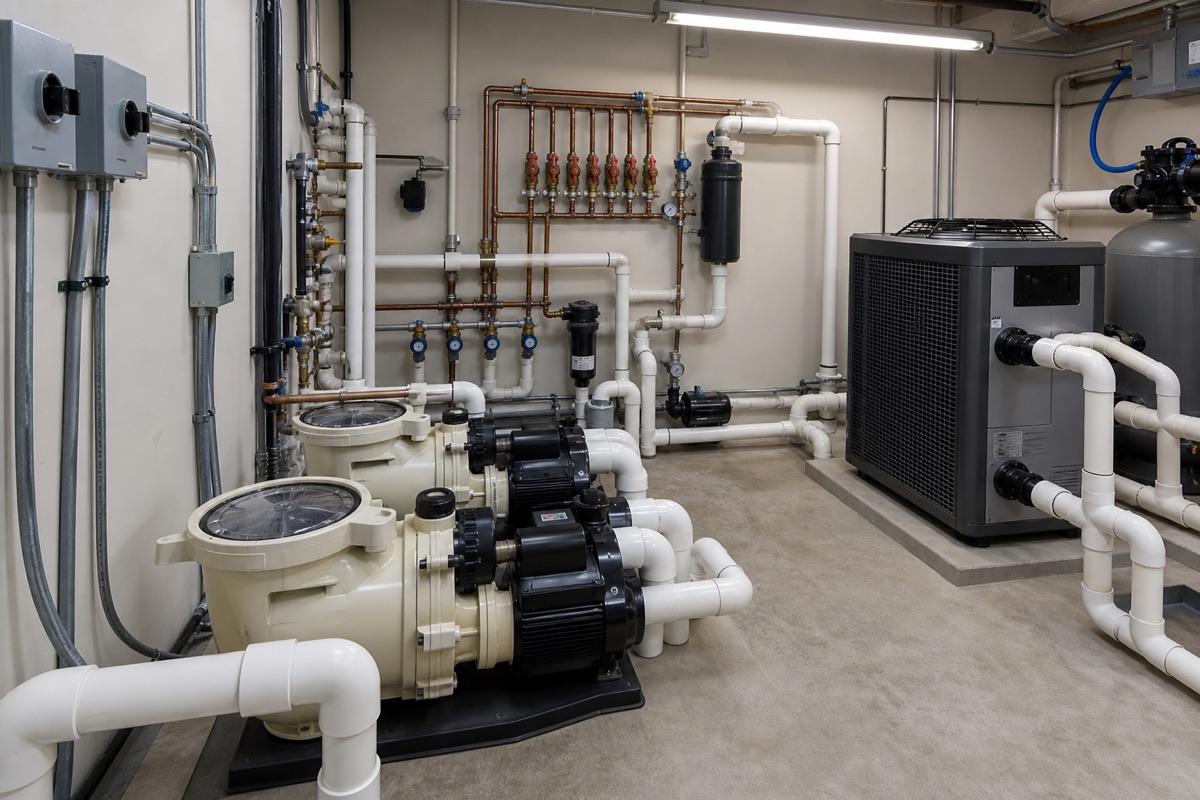
Pool and spa equipment is the plant that moves, filters, heats, and controls water. This hub is a map of those pieces and the room they sit in. It is not a product catalog. Sizing a pump, choosing a heater, and tying a cover to an automation panel are separate decisions that share one pad. Get the room, power, drain, and service access right before you pick a brand. Cover hydraulics or a cover motor may sit in the same room or in a dedicated housing; either way the disconnect has to be on the drawings. Some cover systems can report open and closed state so pumps do not run against a closed fabric; that interlock is a specification item, not a default. Later guides will cover pump sizing and automation in more depth. Until those pages exist, use the matrix below to brief the consultant and the electrician.
What belongs in the plant room?
Pumps, filters, heaters or heat pumps, chemical feed, and controllers. Commercial rooms also need clearances, floor drains, and access that a service tech can use without climbing the pool deck during guest hours.
Cover hydraulics or a cover motor may sit in the same room or in a dedicated housing. Either way, conduit and a labeled disconnect have to be on the drawings.
How does automation meet a cover?
Some cover systems report open and closed state to the pool controller so pumps and features do not run against a closed fabric. That integration is a specification item, not a default.
Key-switch location is a safety item. It should be in sight of the water and away from children, per the manufacturer and the local rule.
Which plant-room interfaces fail first on a covered pool?
The first failure is a pump or water feature that still runs against a closed fabric because nobody specified an open-closed interlock. The second is a key switch that cannot see the water, or that a child can reach. The third is a housing with no labeled disconnect and no path for a tech who is not allowed on the guest deck during hours.
Write the pad as a list: pump and filter duty, heater or heat-pump load for pool versus spa, automation zones, cover power, floor drain, and ventilation. Commercial rooms need clearances a service tech can use. Residential rooms still need a drain that does not empty across the deck. Brand names can wait until those duties are numbers.
This page will not size a pump from volume alone. Head, pipe runs, and required turnover change the curve. A dedicated pump-sizing guide is planned. Until then, treat volume as the start of the conversation, not the answer.
What should the electrician and the cover supplier confirm together?
Motor or hydraulic-power-unit load, disconnect location, conduit path, key-switch sightline, and whether the pool controller will see open and closed state. If those five items are not on one sketch, the pad will be built twice. The cover supplier owns the system limits. The electrician owns the circuit. Neither owns the missing sketch.
Put the key switch where an adult can see the water and a child cannot reach it, per the manufacturer and the local rule. Do not hide it in a closet to keep the deck clean. A clean deck with a blind switch is a safety miss.
Automation that schedules jets against a closed cover is a specification item. Write “interlock required” or “interlock not available” so the controls vendor does not assume a feature that was never bought.
What this hub will not do
It will not pick a pump brand or publish a catalog. It will not size a heater from a screenshot. It will not replace the equipment-room guide that is planned as a child page. Use the matrix to brief the meeting. Bring measured head and turnover to that meeting.
Plant-room briefing list
| Item | Why it is on the list | Who confirms |
|---|---|---|
| Pump and filter | Turnover and pipe velocity | Pool consultant |
| Heater or heat pump | Spa versus pool load and climate | MEP / consultant |
| Automation panel | Zones, schedules, cover interlock | Controls vendor |
| Cover power and housing | Motor or HPU, conduit, disconnect | Cover supplier + electrician |
| Drainage and ventilation | Service and chemical safety | Architect + MEP |
Related hubs
- Pool and Spa Design
Planning a swimming pool and spa as one system: layout, levels, circulation, and the plant room.
- Commercial Pool and Spa Design
Hotel, resort, and commercial aquatic planning for developers, consultants, contractors, and operators.
- Automatic Pool Covers
Types, tracks, retrofit versus new-build, spa covers, safety, and energy for specifying an automatic pool cover.
Questions
- Can I size a pump from pool volume alone?
- Volume is only the start. Head, pipe runs, and the required turnover time change the curve. A dedicated pump-sizing guide is planned next.
- Is this an equipment store?
- No. It is a specification briefing. Buy equipment from a supplier after the room and the duty are defined.
- Does every cover system report open and closed to the pool controller?
- No. That interlock is a specification item. If you need pumps and features to stop against a closed fabric, write it into the brief before anyone bids the controller.